Continental drift, as part of plate tectonics, is the accepted foundation of modern geology. The history in this article is well documented.
In 1912 a German meteorologist named Alfred Wegener stood before a geological society and made a strange claim. The continents, he said, were not fixed. They had once been joined in a single landmass and had slowly drifted apart.
His evidence was not trivial. The coastlines of South America and Africa fit together like torn paper. Identical fossils turned up on continents separated by oceans. Rock formations and traces of ancient glaciers lined up across the Atlantic.
The reaction
Much of the scientific establishment rejected the idea, and some rejected it with contempt. The objection was serious: Wegener could not explain what force could push entire continents through solid rock. Without a mechanism, the evidence looked like coincidence. Wegener died on the Greenland ice sheet in 1930, his theory still on the fringe.
His critics were right to demand a mechanism, and wrong to treat his evidence as nonsense.
The turn
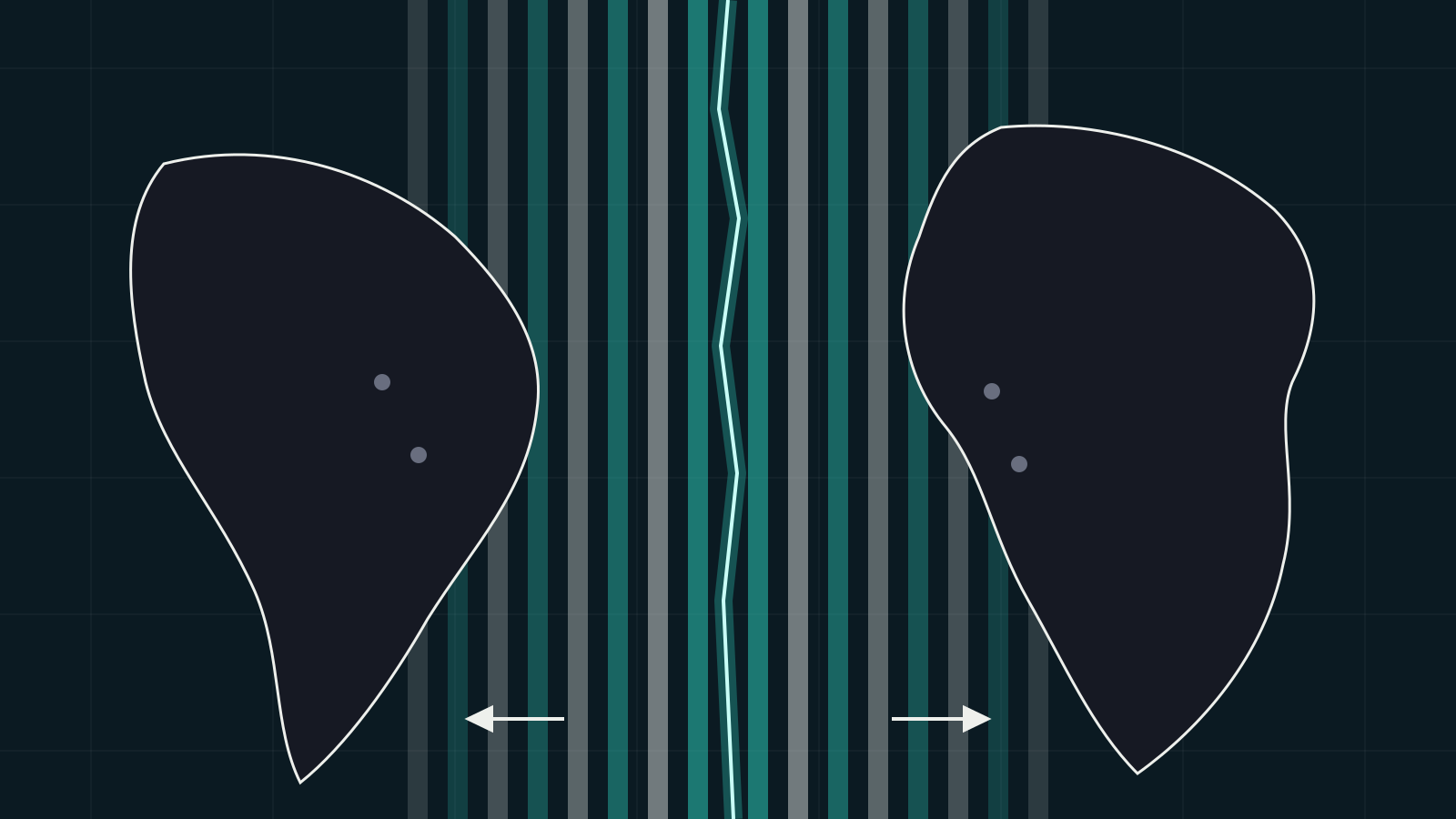
The answer came from the ocean floor. In the 1950s and 1960s, new mapping revealed long volcanic ridges running through the oceans. Harry Hess proposed that new seafloor forms at these ridges and spreads outward. In 1963 Fred Vine and Drummond Matthews showed that the rock on either side of a ridge records stripes of reversed magnetism, in mirror image, like a tape recorder of the Earth's history. The mechanism had been found. Within a decade, plate tectonics became the foundation of geology.
What it teaches us
It is tempting to draw the wrong lesson: that every mocked idea is a hidden truth. It is not. For every Wegener there are many claims that were rejected and deserved to be.
The right lesson is narrower and more useful. Wegener had real evidence and was missing one piece. Good science kept the question open until the data could close it.
That is the attitude Cracked Open exists to practise. Open to the question. Strict about the answer.
Sources
- Alfred Wegener, Die Entstehung der Kontinente und Ozeane (The Origin of Continents and Oceans), 1915.
- Harry H. Hess, "History of Ocean Basins", in Petrologic Studies, Geological Society of America, 1962.
- F. J. Vine and D. H. Matthews, Magnetic anomalies over oceanic ridges, Nature 199, 1963